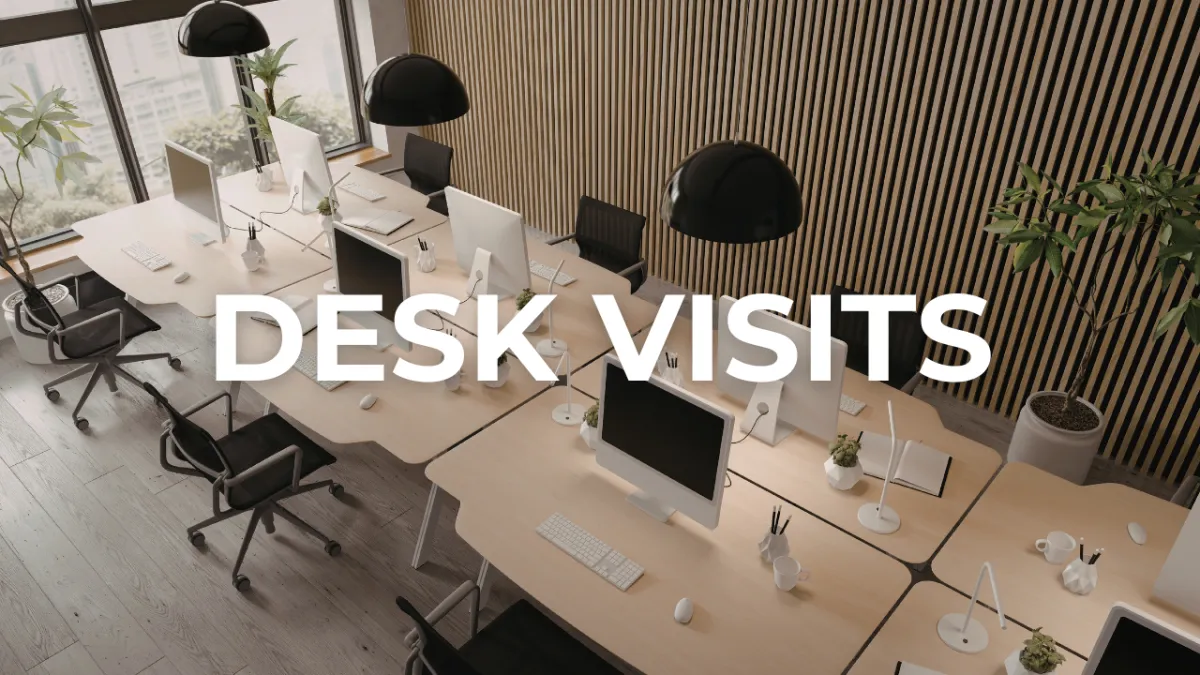
The Desk Visit: The Simple Habit That Gives You Your Day Back
If you're a business owner with a team, you know the feeling. You sit down to do something important (a proposal, a strategy, a financial review) and within ten minutes someone's at your door. "Hey, do you have a minute?"
That minute turns into twenty. You lose your train of thought. You never get back to the deep work. And by the end of the day you've been busy all day but haven't actually moved the business forward.
This is one of the most common complaints I hear from business owners. And the frustrating thing is, most of them think it's just part of running a business. It's not. It's a systems problem. And it has a simple fix.
The Monkey Problem
There's a classic management concept about monkeys. When an employee comes to you with a problem, they've got a monkey on their back. The moment you take on that problem, especially when they've come to your space to deliver it, the monkey jumps from their back to yours. Now it's your problem. Their day gets easier. Yours gets harder.
This happens dozens of times a day in most small businesses. The owner becomes the bottleneck. The team learns, consciously or not, that bringing problems to the boss is the fastest way to get them off their plate.
The desk visit flips that dynamic completely.
What a Desk Visit Actually Looks Like
Twice a day (I use 9am and 3pm as a guide, though you adjust to suit your business) you get up from your desk and you go to your team members. You go to them. Not the other way around.
The questions are slightly different at each visit, and that distinction matters.
At 9am you ask two things: what bottlenecks or problems can I help you clear today, and what are you going to deliver or invoice today? You're setting the day up, clearing the path ahead and anchoring their focus on output.
At 3pm the questions shift: what bottlenecks or problems came up during the day, and what did you actually deliver today? Now you're reviewing, understanding what got in the way and holding the accountability loop closed.
You answer their questions at their desk, in their space. You leave the monkey with them. Then you walk back to your office, close the door, and get into your deep work. You won't be interrupted until 3pm.
The result is that you get a protected block of focused time every single day. And your team gets something valuable too: certainty. They know help is coming. They don't need to interrupt you because they know exactly when they'll get their questions answered. That reduces their anxiety and actually improves their output.
Pair It With the 1-3-1 Rule
The desk visit works even better when you set one expectation with your team upfront. When they bring a problem to the visit, they don't just get to dump it on you. They need to come prepared with three possible solutions and one recommendation.
One problem. Three solutions. One recommendation.
Dan Martell gave this principle a name and articulated it well in his work. I'd been using the same approach for decades without a label for it. Whatever you call it, the effect is the same.
It stops lazy problem-dumping, where someone hasn't thought about the issue at all and just wants you to do their thinking for them. And in most cases, they'll actually solve the problem themselves before you even get there. The act of thinking through three solutions usually reveals the answer.
When they do still need your input, the conversation is faster and more productive. You're not starting from scratch. You're adding context or giving a final call on an option they've already identified.
Why Most Business Owners Don't Do This
It feels counterintuitive at first. You're adding two scheduled interruptions to your day. But what you're actually doing is replacing ten random interruptions with two controlled ones. The maths is obvious once you experience it.
The other resistance I hear is: "My team will think I'm micromanaging." In practice the opposite is true. Desk visits signal that you're invested, that you show up, that you care about removing roadblocks. Done well, with genuine curiosity and without hovering, your team will appreciate it.
I learned this from my first business coach and have used it across every business I've built since. It's one of those things that sounds almost too simple to work, until you try it for a week and wonder how you ever ran a team without it.
Try It This Week
Pick two times. Put them in your calendar as non-negotiables. Tell your team what you're doing and why, including the 1-3-1 expectation. Then go to their desks and do it.
One week. See what it does to your focus, your output, and how your team responds.
If you want to go deeper on building a business that doesn't depend entirely on you being present, that's exactly what we work on with clients inside The Growth CFO System.
